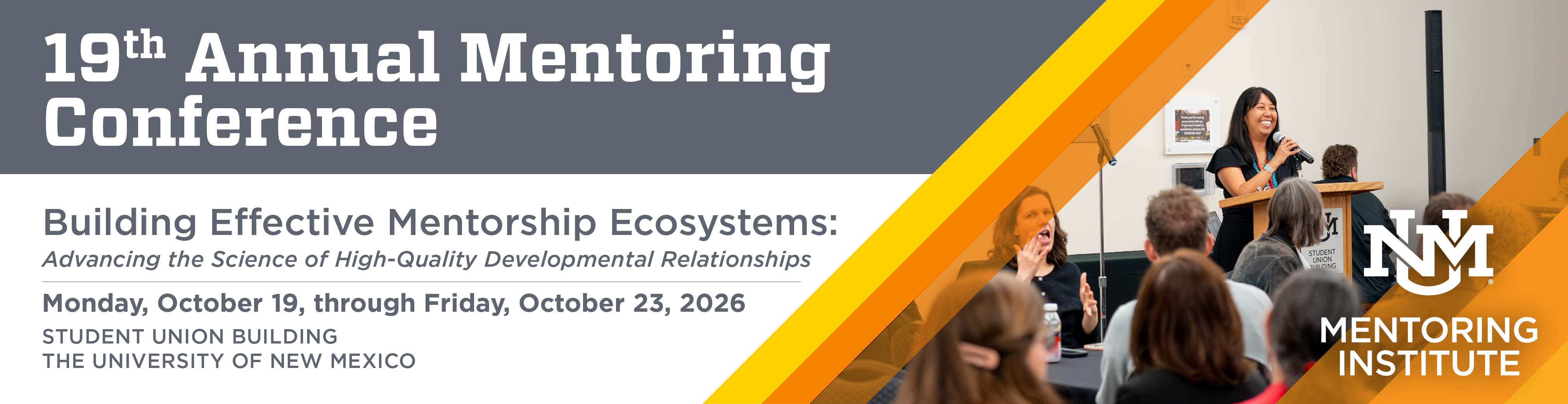
Building Effective Mentorship Ecosystems: Advancing the Science of High-Quality Developmental Relationships
The Mentoring Institute is pleased to announce its 19th Annual Mentoring Conference, Building Effective Mentorship Ecosystems: Advancing the Science of High-Quality Developmental Relationships, to be held Monday, October 19, through Friday, October 23, 2026, at the Student Union Building on the University of New Mexico (Main Campus) in Albuquerque, NM.
Over five days, the conference will convene scholars, practitioners, and leaders to engage in rigorous and generative dialogue through facilitated learning sessions, individual and panel presentations, experiential workshops,and daily plenaries. Together, participants will explore how emotionally intelligent, high-quality developmental relationships—situated within broader developmental networks and mentorship ecosystems—support learning, adaptation, performance, and long-term development across career stages and contexts.
This year’s theme reflects the expanding understanding that mentoring is not only an interpersonal practice but a multilevel developmental process that fundamentally shapes how individuals, organizations, systems, and societies evolve. Across higher education, healthcare, industry, government, and community settings, increasing complexity and persistent challenges demand emotionally intelligent approaches to developmental relationships that extend far beyond traditional dyads.
Grounded in emotional intelligence, positive psychology science, and relational and organizational theories, the conference emphasizes how high-quality developmental relationships—among mentors, coaches, peers, allies, sponsors, brokers, family members, and community partners—can:
Begin as brief developmental interactions (“mentoring moments”),
Grow into sustained one-to-one or group developmental relationships,
Integrate into organizational structures and cultures,
Expand into inter-organizational networks and cross-sector collaborations, and
Ultimately, influence public programs, policy design, and societal ecosystems that support human and institutional potential.
These ecosystems, informed by positive psychology concepts, enable individuals and institutions to achieve higher performance, greater adaptability, stronger collaboration, and greater impact.
Who Should Submit
We welcome proposals from faculty, students, researchers, professionals, and practitioners engaged in mentoring, coaching, supervision, leadership, developmental networks, and relational learning across:
Colleges and universities
K–12 education
Non-profit and NGO organizations
Business and industry
Governmental and public-sector institutions
Submissions are encouraged from all disciplines, identities, sectors, and career stages.
All accepted authors and presenters must participate in the peer review process and register for the conference. Experienced contributors are invited to serve as volunteer peer reviewers.
What We Are Looking for
The 2026 conference theme explores how high-quality developmental relationships, supported by emotional intelligence and positive psychology theories, concepts, frameworks, and tools, operate across developmental networks and mentorship ecosystems to support:
Individual capability and identity development
Career advancement and leadership readiness
Organizational learning, adaptability, and performance
Cross-sector and inter-organizational collaboration
Societal and policy-level efforts to expand developmental support
We invite proposals that examine how positive psychology science enhances the quality, depth, and long-term effectiveness of developmental relationships.
We also seek scholarship and practice insights about how individuals draw developmental support from multiple developers, such as:
Mentors and coaches
Friends, peers, allies, and affinity groups
Sponsors and brokers
Family members and community partners
Institutions, organizations, cross-sector networks, and governmental agencies
We welcome proposals examining developmental support across contexts, including:
One-to-one, group, peer, and team-based formats
Informal, formal, and hybrid arrangements
In-person, virtual, and digitally mediated relationships
Short-term interactions that evolve into long-term developmental networks
Organizational, inter-organizational, governmental, and societal ecosystems
Guiding Questions for Proposal Development
As you develop your proposal, consider questions related to high-quality developmental relationships at the following levels:
Individual Level
Work that examines how individuals develop skills, competencies, and personal growth through one-on-one developmental relationships.
What individual skills, competencies, or psychological resources (e.g., emotional intelligence, strengths, growth mindset) are most predictive of developmental growth in one-on-one relationships?
What distinguishes a high-quality one-on-one developmental relationship from a minimally effective or misaligned one?
Which evidence-based relational practices (e.g., feedback, goal setting, trust building, reflective dialogue) most reliably strengthen one-on-one developmental ties?
How do individuals initiate, sustain, or repair developmental relationships across challenging moments (miscommunication, power differences, identity threat, or conflict)?
Interpersonal Level
Work that focuses on interactions among multiple people, including how individuals engage several developers and how emotionally intelligent exchanges support learning, identity development, and career advancement.
How do individuals build and navigate relationships with multiple developers (mentors, sponsors, peers, coaches, supervisors) across roles, identities, and life stages?
What makes a “mentoring moment” emotionally intelligent and developmentally meaningful in group or networked interactions (e.g., perspective making, emotion regulation, psychological safety)?
How do developmental networks influence learning, identity development, belonging, and career advancement differently than single mentor–mentee relationships?
What relational patterns (reciprocity, brokerage, cohesion, inclusion) are associated with sustained growth and equitable access to developmental support?
Organizational & Interorganizational Level
Work that explores how developmental relationships and networks function within or across institutions, organizations, or sectors to enhance opportunity, equity, mobility, and other system-level outcomes.
How do organizational structures, culture, incentives, and leadership practices enable—or constrain—high-quality developmental relationships?
Which organizational strategies (training, matching, communities of practice, sponsorship structures, evaluation systems) improve relationship quality and outcomes at scale?
How do partnerships across organizations or sectors expand access to developmental support, reduce inequities, and improve mobility or advancement?
What metrics or indicators best capture organizational or interorganizational impact (retention, promotion, climate, belonging, performance, network health, equity outcomes)?
Governmental, Policy, & Societal Level
Work that investigates how public policy, governmental structures, and societal systems shape the design, evaluation, or scaling of mentorship ecosystems and influence broad social impact.
How do governmental policies, funding mechanisms, or regulatory environments shape who has access to developmental support and under what conditions?
What policy levers (workforce development, education policy, health policy, labor policy, professional licensure) could strengthen equitable access to mentoring and sponsorship?
How can mentorship ecosystems contribute to broader societal goals, such as equity, mobility, workforce resilience, innovation, civic leadership, and community well-being?
What evidence or evaluation approaches are most persuasive for demonstrating societal impact and informing policy decisions (cost-benefit, implementation outcomes, population-level indicators)?
Guidelines for Presenters & Reviewers
Enrollment
All presenters must create or update their Mentoring Institute account. Submit abstracts through My Conference after logging in.
By applying to present, accepted authors and co-authors agree to:
Register by May 15, 2026
Participate in the June 1–30 peer review period
Submission of Abstracts
Submission Period: February 15 – April 20, 2026
Four submission types are accepted:
Research Studies
Programs or Projects
Theoretical or Conceptual Models
Systematic Literature Reviews
All abstracts must be 300 words, divided into four 75-word sections:
Introduction and Problem Statement
Use this section to establish the importance and relevance of your work—whether it is research studies, a program or project, a theoretical or conceptual model, or a systematic literature review. Clearly:
Describe the broader issue, challenge, or opportunity your work addresses.
Identify the gap in knowledge, practice, or theory that your submission seeks to fill.
Explain why your topic matters for scholars, practitioners, communities, or institutions.
This section should help readers understand the urgency and significance of your work, and what motivates your inquiry or innovation.
Conceptual and Theoretical Framework
Use this section to orient readers to the intellectual and scholarly foundation of your work. Depending on the submission type:
Research Studies: Summarize your research questions and the theoretical or conceptual literature informing your study.
Programs or Projects: Describe the principles, evidence base, or conceptual grounding that guided your design and implementation.
Theoretical or Conceptual Models: Outline the major constructs, relationships, or propositions that define your model.
Systematic Literature Reviews: Summarize the scope of the literature, central concepts reviewed, and the rationale for conducting the review.
This section should make clear what is already known, where your work sits within existing scholarship, and how it advances, challenges, or synthesizes prior work.
Methodology / Approach
This section describes how your research, program, model, or review was conducted. Expectations vary by submission type:
Research studies: Summarize your methodology (qualitative, quantitative, or mixed methods), data sources, sampling approach, and analytic strategies, including any cross-level or cross-context components.
Program or project reports: Explain the program design, implementation process, participant or stakeholder groups, tools or interventions used, and evaluation or assessment strategies.
Theoretical or conceptual work: Describe how the model or framework was developed—for example, through literature synthesis, conceptual integration, or practice-based insights.
Systematic literature reviews: Identify your search strategy, databases used, inclusion/exclusion criteria, analytic method (e.g., thematic synthesis, integrative review), and how the evidence was organized and interpreted.
This section should demonstrate rigor, transparency, and coherence in your approach.
Contributions, Outcomes & Implications
Use this final section to clarify the significance of your work. Depending on the submission type, this may include:
Key research findings, themes, or patterns.
Program or project results, lessons learned, or demonstrated impact.
Insights from theoretical or conceptual models that clarify mechanisms, propose new constructs, or integrate existing knowledge.
Synthesis and findings from systematic reviews, such as identified gaps, emerging trends, or consolidated evidence.
Finally, explain the implications of your work for research, practice, policy, or future program development. Conclude with one or two sentences that highlight the importance of your contribution and how it can inform future scholarship or institutional improvement.
Expectations for Accepted Presentations
Acceptance notification: April 30, 2026
Presentation length: 45 minutes
30-minute presentation
10 minutes Q&A
5-minute evaluation
Paper submission (5–7 pages): Due May 30, 2026
Papers will be published in The Chronicle of Mentoring and Coaching
All accepted authors must review 3–5 papers in June
Registration & Presenter Benefits
All presenters, authors, and reviewers must register to appear in the final program and the corresponding publication.
Presenter Fee: $500 ($100 presenter discount applied to the standard $600 fee)
Access to all plenaries, keynotes, and facilitated sessions
Student Fee Waivers
Full-timepresenting undergraduate students who will appear as first author(s) in the corresponding paper may request a registration fee waiver by April 15, 2026, by emailing mentor@unm.edu with: